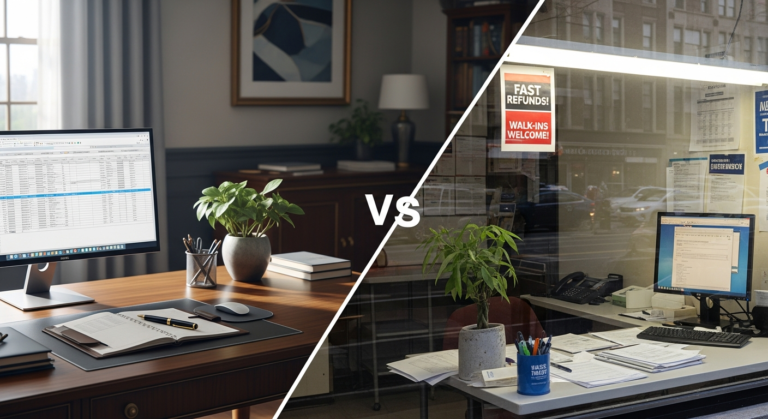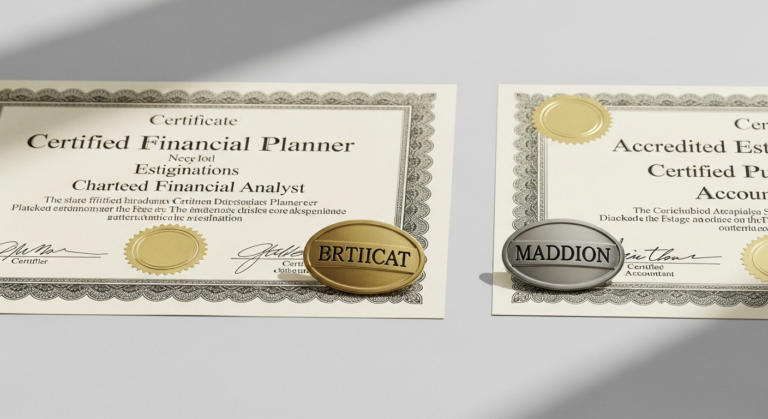
CPA vs. Tax Preparer: Understanding the Difference Before You Choose
Last Updated: 2025
If you've ever searched for someone to prepare your taxes, you've encountered a confusing landscape. Firms with national brand names, independent preparers with storefronts, professionals with initials after their names, and online software that claims it can do everything a human can. What you may not have realized is that the people available to prepare your tax return range from completely unlicensed (no credentials required in most states) to professionals who spent years earning one of the most difficult licenses in any profession.
The distinction matters — not because a lower-credential preparer always does bad work, but because when things go wrong, or when your situation has genuine complexity, the difference between a CPA and an unlicensed preparer can be enormous. This guide explains the full spectrum of tax professionals, makes a clear comparison between CPAs and non-credentialed preparers, and helps you understand when each type is — and isn't — the right choice.
Table of Contents
- The Spectrum of Tax Professionals
- Unlicensed Tax Preparers: Anyone Can Hang a Shingle
- PTIN Holders: The Minimum IRS Requirement
- The Annual Filing Season Program (AFSP)
- Enrolled Agents: IRS-Credentialed Tax Specialists
- Certified Public Accountants (CPAs)
- Tax Attorneys
- CPA vs. Non-Credentialed Preparer: The Direct Comparison
- IRS Representation Rights: A Critical Distinction
- The National Chain Context: H&R Block, Jackson Hewitt, and Others
- When a CPA Is Clearly the Right Choice
- When a Non-CPA Preparer May Be Adequate
- The Consumer Protection Argument for Credentialed Preparers
- Frequently Asked Questions
- Conclusion
The Spectrum of Tax Professionals
The universe of people who can legally prepare a federal tax return for compensation is large and varied. At the bottom of the spectrum: essentially anyone, in most states, can prepare tax returns for pay with minimal regulatory requirements. At the top: licensed attorneys, CPAs, and Enrolled Agents — professionals who have passed rigorous examinations, hold valid licenses, and are subject to formal disciplinary systems.
Understanding where various professionals fall on this spectrum — and what that means for the quality of their work and the protections available to you — is the foundation of making an informed choice.
Unlicensed Tax Preparers: Anyone Can Hang a Shingle
The Shocking Reality
In the United States, the federal government does not require tax preparers to hold any specific credential, pass any test, or demonstrate any competency before preparing and filing tax returns for paying clients. Anyone who obtains a Preparer Tax Identification Number (PTIN) from the IRS — which requires identity verification and payment of a user fee, but no examination or credential — can legally prepare and sign tax returns for compensation.
A few states have imposed their own preparer registration or testing requirements (California, Maryland, New York, Oregon, Connecticut, and a handful of others), but the majority of states impose no such requirements.
The IRS attempted to implement a comprehensive preparer competency testing and registration program (the Registered Tax Return Preparer program) in 2011, but that program was struck down by federal courts in 2014 in Loving v. IRS on the grounds that the IRS lacked statutory authority to impose such requirements.
What This Means for Consumers
The practical consequence: when you choose a tax preparer, the credential they hold (or don't hold) tells you something important about their accountability and verified competence. A person who calls themselves a "tax professional" or "tax specialist" may have extensive experience and provide excellent service — or may have attended a single weekend training session. Without a credential, you can't distinguish between them based on a title alone.
PTIN Holders: The Minimum IRS Requirement
What a PTIN Is
A Preparer Tax Identification Number (PTIN) is required by the IRS for any paid preparer who signs a federal tax return. It replaced the use of Social Security numbers on returns for identity protection purposes. Obtaining a PTIN requires:
- Completing an application with the IRS
- Verifying identity and foreign status (if applicable)
- Disclosing certain tax compliance and criminal history information
- Paying an annual user fee (currently $19.75 per year)
What a PTIN Does Not Require
A PTIN does not require:
- Any education
- Any examination
- Any demonstration of tax knowledge
- Any professional credential
- Continuing education
The PTIN is the absolute floor of federal requirement for paid tax preparers. Someone who holds only a PTIN and no other credential has met the minimum legal requirement to prepare returns for compensation — nothing more.
The Annual Filing Season Program (AFSP)
What the AFSP Is
After the Registered Tax Return Preparer program was struck down, the IRS created the voluntary Annual Filing Season Program (AFSP) as a way to encourage non-credentialed preparers to pursue continued education and demonstrate some level of competency.
AFSP participation requires:
- Completing 18 hours of continuing education from IRS-approved providers (15 hours for PTIN holders who have participated in certain prior education programs)
- The 18 hours must include 6 hours of federal tax law updates, 10 hours of other federal tax topics, and 2 hours of ethics
- Passing the Annual Federal Tax Refresher (AFTR) course and examination
Participants receive an Annual Filing Season Program — Record of Completion from the IRS and are included in a public directory of credentialed preparers.
AFSP Representation Rights
AFSP participants who have a valid Record of Completion have limited representation rights before the IRS — they can represent clients during examinations of returns they prepared, specifically for returns filed after December 31, 2015. This is a significant benefit over non-AFSP PTIN-only holders, who have no representation rights beyond returning to the IRS with information.
However, AFSP representation rights are limited to audits of returns the preparer prepared. They cannot represent clients in appeals, collection matters, or other IRS proceedings.
Enrolled Agents: IRS-Credentialed Tax Specialists
What an Enrolled Agent Is
An Enrolled Agent (EA) is a federally licensed tax practitioner authorized by the U.S. Department of the Treasury. The EA credential is the only federally issued tax professional credential. EAs are authorized to represent taxpayers before the IRS in all matters.
How to Become an Enrolled Agent
There are two paths to the EA credential:
Path 1: Pass the Special Enrollment Examination (SEE)
The SEE is a comprehensive three-part exam covering individual taxes, business taxes, and representation/ethics. Each part must be passed within a specified testing window. The exam is administered by Prometric, the same company that administers the CPA Exam.
Path 2: Former IRS Employment
Former IRS employees who worked in certain technical positions for a minimum period (typically five years) may apply for EA status without taking the SEE, based on their IRS technical experience.
EA Continuing Education
EAs must complete 72 hours of continuing education every three years (at least 16 hours per year), including at least 2 hours of ethics per year. EA continuing education requirements are administered by the IRS.
EA Strengths
EAs are often excellent choices for tax work, particularly:
- Complex individual tax situations
- Small business tax compliance
- IRS audit representation
- Back tax resolution and IRS problem resolution
- Situations where deep tax expertise is needed but audit services are not
The EA credential demonstrates genuine IRS-tested tax expertise. Many EAs are among the most technically skilled tax professionals available.
EA Limitations
EAs are not licensed CPAs. They generally cannot:
- Perform financial statement audits, reviews, or compilations
- Provide attest services
- Sign audit reports
- Perform some state-level services that require a CPA license
For pure tax work, an EA can be as strong or stronger than a CPA. For services that require the CPA license specifically, an EA is not a substitute.
Certified Public Accountants (CPAs)
What a CPA Is
A Certified Public Accountant is a state-licensed professional who has met education requirements (150 semester hours of college education), passed the four-section Uniform CPA Examination, completed supervised experience (typically 1-2 years), passed an ethics examination, and been issued a license by a state board of accountancy. The license must be renewed periodically, and ongoing continuing professional education (typically 40 hours per year) is required.
The Scope of CPA Services
CPAs provide the broadest range of financial professional services of any credential:
- Federal, state, and local tax preparation and planning for individuals, businesses, estates, and trusts
- Financial statement audits, reviews, and compilations (only CPAs can sign audit reports for most purposes)
- Bookkeeping and accounting services
- Payroll and business advisory services
- IRS representation with unlimited rights
- Estate and trust administration
- Business valuation and forensic accounting
CPA Strengths
The CPA's combination of breadth (covering tax, audit, accounting, advisory, and financial planning), depth (built on extensive education and one of the most challenging professional exams), state licensing (with a formal disciplinary system), and ongoing CPE requirements makes it the highest-accountability general credential in the financial services space.
For clients with complex needs — business owners, high-income individuals, those with investments, real estate, or equity compensation, anyone facing an IRS matter — the CPA's combination of technical competence, accountability, and full IRS representation rights is the strongest package available from a single professional.
Tax Attorneys
What a Tax Attorney Is
A tax attorney is a licensed attorney (JD degree, state bar admission) who specializes in tax law. Tax attorneys are best suited for:
- Complex tax litigation (Tax Court, federal district court, appeals)
- Criminal tax investigations
- Complex international tax matters
- Tax planning in highly complex transactions
- Estate planning with significant wealth transfer
- Situations where attorney-client privilege is important (which CPAs do not have in most circumstances)
When to Use a Tax Attorney vs. a CPA
Most individuals and small businesses never need a tax attorney. They're the specialist you bring in for truly complex legal tax situations — not for annual compliance or typical planning. For the vast majority of small businesses and individual taxpayers, a CPA (or EA) is the right professional for tax needs.
CPA vs. Non-Credentialed Preparer: The Direct Comparison
| Dimension | CPA | Non-Credentialed Preparer |
|---|---|---|
| Education | 150 semester hours required | None required (in most states) |
| Examination | 4-section Uniform CPA Exam (45-55% pass rate per section) | None required |
| License | State-issued professional license | None (PTIN only) |
| Oversight Body | State Board of Accountancy | IRS (PTIN discipline only) |
| Disciplinary System | Formal state board proceedings, license suspension/revocation | Limited IRS sanctions for PTIN holders |
| IRS Representation | Unlimited representation rights before IRS | No representation rights (PTIN-only) |
| CPE Required | 40 hours/year (typically) | None required (optional AFSP) |
| Audit Services | Can sign audit reports and perform attest services | Cannot |
| Service Scope | Full spectrum: tax, audit, accounting, advisory | Typically limited to tax preparation |
| Accountability | Professional ethics rules, state disciplinary system, E&O insurance | No formal professional accountability system |
Education
The 150-hour education requirement for CPAs is equivalent to five years of college study. It includes extensive coursework in accounting, taxation, auditing, and business. A non-credentialed preparer may have attended a brief tax preparation training course, earned a GED, or have no formal tax education at all. There is no way to know from the title alone.
Examination
The Uniform CPA Examination is one of the most difficult professional exams in the United States. Each of the four sections has a roughly 45-55% cumulative pass rate. Candidates typically spend hundreds of hours studying for the exam and many require multiple attempts. There is no equivalent examination requirement for non-credentialed preparers.
Disciplinary Accountability
If a licensed CPA behaves unethically, prepares fraudulent returns, or breaches professional standards, a client can file a complaint with the state board of accountancy. The board has authority to investigate, impose sanctions, suspend the license, or revoke it permanently. This removes the CPA's ability to practice.
If an unlicensed, non-credentialed preparer does the same, your options are limited to: a civil lawsuit (expensive and uncertain), an IRS complaint (which may result in PTIN revocation but does little to compensate you), or a state-law fraud claim. There is no professional license to revoke — because there was no license to begin with.
IRS Representation Rights: A Critical Distinction
IRS representation is one of the most important and least understood distinctions between credential levels.
Unlimited Representation Rights
CPAs, Enrolled Agents, and tax attorneys hold unlimited representation rights before the IRS. This means they can represent clients in:
- All IRS audit examinations (correspondence, office, and field audits)
- IRS Appeals
- Collection matters (installment agreements, offers in compromise, liens, levies)
- Tax Court cases (for CPAs and EAs who are admitted to practice)
- All other IRS administrative proceedings
When you face an IRS examination or collection matter, having a CPA or EA as your representative means you have an authorized professional speaking for you. You don't have to deal with the IRS directly.
AFSP Participants: Limited Representation
AFSP participants can represent clients only in examinations of returns they prepared. They cannot handle appeals or collection matters.
PTIN-Only Preparers: No Representation Rights
A preparer who holds only a PTIN and no other credential has no IRS representation rights. If their client receives an audit notice, the preparer can accompany the taxpayer as a witness — but they cannot speak on the taxpayer's behalf, submit documentation on their behalf, or represent them in any formal sense. The taxpayer handles the audit themselves or must hire a credentialed professional.
This matters enormously in practice. Tax returns prepared by non-credentialed preparers have higher error rates and potentially higher audit risk. If that return gets audited, the preparer cannot help you through the audit — you're on your own unless you hire separate representation.
The National Chain Context: H&R Block, Jackson Hewitt, and Others
What National Tax Chains Are
National tax preparation chains — H&R Block, Jackson Hewitt, Liberty Tax, and similar — are franchise networks of retail tax preparation locations. The preparer at your local franchise location may be a CPA, an EA, or a non-credentialed seasonal employee who completed the chain's internal training program. The chain's branding does not indicate the credential of the individual preparer.
H&R Block Specifically
H&R Block employs preparers across a wide credential spectrum:
- Some locations are staffed by CPAs or EAs
- Many locations primarily employ preparers who have completed H&R Block's own training program (which is more extensive than nothing but less rigorous than professional credential programs)
- H&R Block offers its own certification program (the "H&R Block Tax Associate" or "H&R Block Master Tax Advisor" designations) — these are internal credentials, not externally licensed credentials
H&R Block's scale also means considerable consistency in software and process, which provides some quality floor even for less experienced preparers on simple returns.
When Chain Preparers Are Sufficient
For genuinely simple returns — a W-2 employee with no investments, no business income, no rental properties, no equity compensation, standard deduction, a mortgage, and a couple of children — the mechanical complexity is low enough that a well-trained non-CPA preparer can handle the work competently. The chain's software assists with this.
When Chain Preparers Fall Short
For anything beyond a simple return, the limitations of seasonal, non-credentialed preparers become significant:
- Year-round availability: Most chain locations are seasonal (January through April). If your situation has a year-round complexity or you need mid-year planning, you can't reach your preparer.
- Continuity: Chain preparers change year to year. There is no ongoing relationship, no institutional memory of your tax history, and no one who knows your situation.
- Complex situations: Self-employment, rental properties, equity compensation, business ownership, multi-state issues, international income — these require expertise that seasonal chain preparers often don't have.
- Audit representation: As noted, non-credentialed preparers cannot represent you in an IRS audit.
When a CPA Is Clearly the Right Choice
Choose a CPA when:
- You own a business or have self-employment income above approximately $75,000
- You have rental properties (passive activity rules, depreciation, possible real estate professional status)
- You receive equity compensation (RSUs, ISOs, NSOs, carried interest)
- You have significant investment income, including capital gains requiring careful planning
- You face or anticipate an IRS audit, notice, or collection matter
- You need mid-year tax planning, not just year-end preparation
- Your tax situation involves multiple states with apportionment issues
- You have foreign income, foreign accounts (FBAR/FATCA), or expatriate status
- You are buying or selling a business
- You have estate planning complexity or inherited assets requiring tax decisions
- Your financial situation is changing significantly in ways that have tax implications
In all of these situations, the combination of education, credentialed expertise, full IRS representation rights, and ongoing professional accountability makes a CPA significantly more valuable than a less-credentialed alternative.
When a Non-CPA Preparer May Be Adequate
A non-CPA preparer — particularly an Enrolled Agent or a well-trained seasonal preparer — may be adequate when:
- Your return involves only W-2 income, the standard deduction, and basic credits
- You have a simple Schedule C with clear income and documented expenses but no employees or complex issues
- Your tax situation has been unchanged for several years with no planned changes
- You don't need year-round access or planning advice
- You're price-sensitive and understand the limitations of non-CPA service
Even in these situations, the risk of errors isn't zero with non-credentialed preparers. And the inability to have your preparer represent you in an audit is a limitation worth considering.
The Consumer Protection Argument for Credentialed Preparers
The case for choosing a credentialed preparer — particularly a CPA or EA — is fundamentally about accountability.
Multiple Layers of Accountability
A CPA faces accountability from multiple directions simultaneously:
- State Board of Accountancy: Can revoke the license
- AICPA: Can impose member disciplinary sanctions
- IRS Office of Professional Responsibility (OPR): Can disbar the CPA from practice before the IRS under Circular 230
- Professional liability (E&O) insurance: Provides a compensation mechanism if errors cause harm
- Civil liability: CPAs can be sued for malpractice under professional negligence standards
An unlicensed, non-credentialed preparer faces only:
- IRS PTIN revocation (prevents signing future returns, but nothing else)
- Civil lawsuit (which you must file and win)
The Asymmetry of Risk
For a simple return, the difference in accountability might not matter — the return is straightforward enough that errors are unlikely. But for any situation with complexity or significant tax liability, the accountability differential is substantial. If a CPA makes a significant error, you have formal channels to seek remedy. If a non-credentialed preparer does, you're largely on your own.
Frequently Asked Questions
Q: Is an Enrolled Agent better than a CPA for tax work?
Not necessarily better or worse — different. EAs are federally licensed specifically for tax practice. Many EAs are highly skilled tax practitioners with deep expertise in IRS procedures and complex tax situations. CPAs have broader scope (they can also perform audits and provide a wider range of accounting services) and are state-licensed. For pure tax work, an EA can be equal to or exceed a CPA in technical depth. For a business that needs both tax services and financial statements or accounting support, a CPA is typically the better fit.
Q: Do national chains use licensed CPAs?
Some do, some don't. The credentials of the preparer you work with at a national chain location depend on the specific location and preparer. It's reasonable to ask directly: "Are you a CPA, Enrolled Agent, or hold another credential?" before allowing someone to prepare your return. Don't assume that a branded location implies a specific credential level.
Q: Can a non-credentialed preparer take on my case if the IRS audits me?
No. A non-credentialed, PTIN-only preparer has no IRS representation rights. They cannot speak on your behalf, submit documentation as your representative, or participate in audit proceedings in any formal capacity. If you've had your return prepared by a non-credentialed preparer and face an audit, you'll need to either handle it yourself or hire a CPA, EA, or tax attorney to represent you.
Q: How much more does a CPA cost than a non-credentialed preparer?
The cost difference varies significantly. A non-credentialed seasonal preparer might charge $150-$400 for a relatively simple return. A CPA might charge $400-$800 for a similar return, or significantly more for complex situations. The difference in cost is real. The question is whether the additional accountability, expertise, representation rights, and year-round availability are worth the premium for your situation. For complex situations, they typically are.
Q: What happens if my tax preparer makes a mistake?
If a credentialed professional (CPA or EA) makes an error, you can file a complaint with the state board of accountancy (for CPAs) or the IRS Office of Professional Responsibility (for EAs). You may also have a malpractice claim if the error caused financial harm. If a non-credentialed preparer makes an error, your options are primarily civil lawsuit, which is expensive and uncertain. The IRS generally holds taxpayers responsible for errors in their returns regardless of who prepared them, though reasonable cause arguments can sometimes reduce penalties.
Conclusion
The landscape of tax professionals is wide, and the differences between credential levels matter significantly. At one end: unlicensed, non-credentialed preparers who have met the bare minimum federal requirement (a PTIN) and who are accountable to no professional body with meaningful authority over their practice. At the other end: CPAs and Enrolled Agents who have passed rigorous examinations, hold government-issued licenses, comply with mandatory CPE requirements, are subject to formal disciplinary systems, and hold full IRS representation rights.
For simple, unchanging returns with no complexity, a less-credentialed preparer may get the job done adequately. For any situation involving business income, investments, real estate, equity compensation, multi-state issues, planning opportunities, or IRS exposure — the protection and expertise of a CPA or Enrolled Agent is worth the additional investment.
The credential question isn't about elitism. It's about accountability, expertise, and protection. When your financial situation has real complexity — or real stakes — you want a professional who is accountable for their work.
Our licensed CPAs provide expert tax preparation, proactive tax planning, and full IRS representation for individuals and businesses. Contact us to discuss your situation and learn how working with a licensed CPA differs from other options.
Related Articles:
- CPA vs. Enrolled Agent: Which Tax Professional Do You Need?
- CPA vs. H&R Block: When a Tax Chain Is Enough and When It Isn't
- Should I Hire a CPA for Taxes?
- What Is a CPA? Understanding the Credential
Making the Switch: Moving from a Non-Credentialed Preparer to a CPA
If you've been using a non-credentialed or chain preparer and are considering switching to a CPA firm, the transition is simpler than most people expect.
What You Need to Bring
When you first engage a CPA, bring the last two to three years of tax returns (business and personal) and any notices or correspondence from the IRS. The CPA will review prior returns as part of understanding your history. This review often surfaces issues — missed deductions, incorrect elections, suboptimal filing positions — that can be corrected through amended returns where the statute of limitations is still open.
The IRS generally allows amended returns within three years of the original filing date or two years from the date tax was paid, whichever is later. If a prior preparer made errors that cost you money, there may be refund potential that an amended return could recover.
What to Expect in Year One
In the first year with a CPA, expect a thorough intake conversation about your financial situation, goals, and history. The CPA needs to understand not just what happened last year but what you're expecting to happen going forward. This context is what allows them to provide planning advice rather than just filing a return.
You may also encounter a different process for document collection, a secure client portal for sharing sensitive information, and a more structured approach to communication and deadlines. These process differences reflect the firm's systems for managing quality — they're features, not friction.
The First Planning Conversation
One of the most valuable things a new CPA relationship produces is a first planning conversation — ideally in your first tax season together, and then on an ongoing annual or semi-annual basis. This conversation covers: What is your projected income for the year? What significant transactions are anticipated? What are your financial goals? What tax situations are developing that we should address now?
Many people who have only used seasonal preparers have never had this conversation. The first time it happens — when a CPA tells you that you can reduce your tax bill by $8,000 by making a specific retirement contribution before December 31 — it reframes how you think about the CPA relationship. It's not a cost center. It's one of the highest-return investments available to a small business owner or higher-income individual.