CPA for Contractors: Tax and Accounting Guide for Construction and Trade Businesses
Last Updated: 2025
The construction and contracting industry presents a unique set of accounting and tax challenges that don't exist in most other businesses. Job costing, retainage, the percentage-of-completion method, home improvement vs. repair classifications, equipment depreciation, subcontractor 1099 compliance, and complex multi-state tax obligations all make contractor accounting one of the most specialized areas in public practice.
Unfortunately, many contractors work with CPAs or bookkeepers who don't understand the construction industry — and the result is inaccurate job profitability tracking, tax overpayment, misclassified workers, and financial reporting that doesn't tell the real story of the business.
This guide covers the most important accounting and tax considerations for contractors, general contractors, subcontractors, and home improvement businesses.
Table of Contents
- The Contractor's Accounting Challenges
- Job Costing: The Foundation of Contractor Profitability
- Construction Revenue Recognition Methods
- Equipment Depreciation and Section 179 for Contractors
- Subcontractor 1099 Compliance
- Worker Classification: Employee vs. Independent Contractor
- Retainage Accounting
- Construction Industry Tax Deductions
- Bonds, Insurance, and Financial Prequalification
- Business Entity Structure for Contractors
- Multi-State Tax Obligations
- Frequently Asked Questions
- Conclusion
The Contractor's Accounting Challenges
Construction accounting differs from standard business accounting in ways that catch many contractors and their non-specialized accountants off guard:
Project-based accounting: Unlike a retail store or service business that has relatively consistent revenue, a contractor's revenue comes from discrete projects — each with its own cost structure, timing, and profitability profile. Standard bookkeeping that just records income and expenses is insufficient; you need job-by-job cost and revenue tracking to understand which jobs are profitable and which aren't.
Long-term contracts: Many construction projects span multiple accounting periods. When should revenue be recognized? When the contract is signed? When work is performed? When cash is received? The answer depends on the contract type and the applicable revenue recognition rules — and getting it wrong can significantly misstate your income and tax liability.
Retainage: Many construction contracts hold back 5-10% of each progress payment until project completion. This retainage creates accounts receivable that don't convert to cash for months or years — and must be accounted for correctly.
Subcontractor management: Most contractors use subcontractors, who must receive Form 1099-NEC for payments of $600+. Missing or incorrect 1099s create IRS issues and can jeopardize the deductibility of payments.
Equipment: Heavy construction equipment is a major capital investment with complex depreciation rules, sales and use tax implications, and lease-vs-buy decisions.
Job Costing: The Foundation of Contractor Profitability
Job costing is the practice of tracking all costs — labor, materials, subcontractors, equipment use, overhead — attributed to each specific job or project. It's the most important accounting practice for a contractor, and the one most commonly neglected.
Why job costing matters:
Without job costing, you know whether the business overall made money — but not which jobs made money and which lost it. This blindness allows unprofitable work patterns to continue unchecked, leads to poor pricing on future bids, and prevents you from identifying which job types, customers, or project sizes are your most and least profitable.
The job costing framework:
For each job, track:
- Direct labor: Actual hours worked by your employees on the job × their loaded labor rate (wage + payroll taxes + benefits)
- Materials: All materials purchased specifically for or allocated to the job
- Subcontractors: All subcontractor invoices for work on the job
- Equipment: Ownership or rental costs allocated to job time
- Overhead allocation: A portion of fixed overhead (office, insurance, vehicles) allocated to each job based on a reasonable method (often labor hours or direct costs)
The profit comparison:
Comparing actual job costs to your original estimate reveals where projects went over or under — which feeds better future estimating. A CPA helps you set up job costing in your accounting software and review job cost reports regularly.
Accounting software for contractors:
Construction-specific software (Buildertrend, CoConstruct, Foundation, Sage 300 Construction) often handles job costing better than general accounting software. For smaller contractors, QuickBooks Online with proper setup can also work. A CPA experienced in construction helps you choose and configure the right system.
Construction Revenue Recognition Methods
For tax purposes, contractors must choose a method of recognizing revenue that correctly matches income to the periods when it's earned:
Cash Method: Revenue recognized when received, expenses when paid. Simple but can distort income for long-term contracts. Available only to smaller contractors (average annual gross receipts under $29 million for 2024).
Completed Contract Method (CCM): Revenue and expenses for a project are recognized only when the project is substantially complete. Creates a "lumpy" income pattern and can defer taxes — but may backfire if multiple large projects complete in the same year. Available for contractors with average annual gross receipts under $29 million and contracts completing within 2 years.
Percentage of Completion Method (PCM): Revenue is recognized proportionally as the project is completed, based on costs incurred to date as a percentage of estimated total costs. Required for most long-term contracts for larger contractors. Provides the most accurate picture of profitability but requires more sophisticated accounting.
Look-back rule: If you use PCM, you may be required to recalculate income when the contract is completed and pay interest on any tax underpaid in prior years (or receive interest on tax overpaid). A CPA manages this calculation.
Equipment Depreciation and Section 179 for Contractors
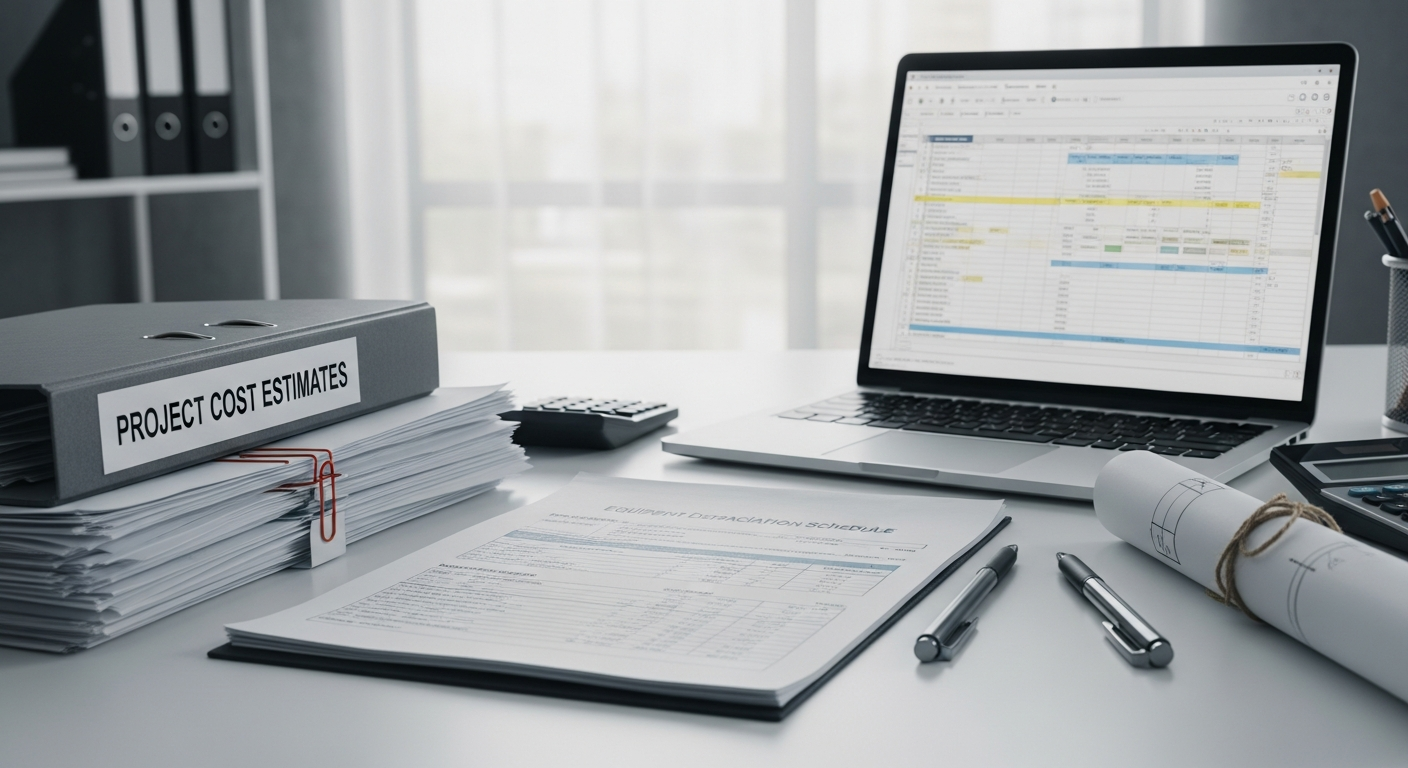
Construction equipment represents a major investment — backhoes, excavators, trucks, trailers, scaffolding, tools — and the tax treatment of these assets can significantly affect your annual tax liability.
Section 179 Expensing:
Under Section 179, you can deduct the full cost of qualifying equipment in the year it's placed in service, up to $1,220,000 (2024 limit). This immediately reduces taxable income rather than spreading the deduction over the asset's useful life.
Bonus Depreciation:
In addition to Section 179, bonus depreciation allows an additional percentage (60% in 2024, phasing down from 100% in prior years) of qualifying property to be expensed in the first year. The combination of Section 179 and bonus depreciation can make equipment purchases nearly fully deductible in year one.
Heavy vehicle deduction:
Vehicles with a Gross Vehicle Weight Rating (GVWR) over 6,000 pounds (common for contractor trucks and SUVs) have higher first-year deduction limits than passenger cars. A pickup truck used 100% for business can be deducted under Section 179 or bonus depreciation.
Lease vs. buy analysis:
A CPA models the after-tax cost of leasing vs. purchasing equipment, considering the time value of money, tax benefits, and operational flexibility.
Subcontractor 1099 Compliance
If you pay subcontractors $600 or more in a calendar year, you must issue Form 1099-NEC by January 31 of the following year. This is a legal requirement — and failure to comply has consequences.
What happens if you don't file 1099s:
- IRS penalties: $50-$290 per missing form (depending on lateness), up to $1,193,500 per year
- Risk of audit that questions whether sub payments are deductible without documentation
- Potential backup withholding obligations if subcontractor's TIN is missing
Collecting W-9s:
Before paying any subcontractor, collect Form W-9 (Request for Taxpayer Identification Number). This documents their legal name, address, and TIN (SSN or EIN). Don't start work without it.
Who gets a 1099:
Unincorporated contractors (sole proprietors, LLCs, partnerships) receiving $600+ in the year. Corporations generally don't get 1099s (with exceptions for attorney fees and certain other payments).
A CPA ensures:
- Your W-9 collection process is documented
- 1099s are issued accurately and on time each January
- Backup withholding is applied when required (missing TIN)
- Subcontractor payments are properly tracked throughout the year
Worker Classification: Employee vs. Independent Contractor
Worker classification is one of the highest-risk areas for contractors — and one of the most frequently audited by both the IRS and state labor agencies.
The core test:
Whether a worker is an employee or independent contractor depends on the degree of control and independence. The IRS uses a multi-factor test (behavioral control, financial control, type of relationship). California uses the even stricter ABC test.
The stakes of misclassification:
If workers you've classified as independent contractors are determined to be employees, you owe:
- Back employment taxes (employer's share of FICA — approximately 7.65%)
- Withholding for income taxes the workers should have paid
- State unemployment taxes
- Penalties and interest
- Back workers' compensation premiums
- Potential liability for back wages and benefits
This can be catastrophic — especially for a contractor with many workers who has been misclassifying for multiple years.
Safe harbor (Section 530 Relief):
A contractor who has consistently and reasonably treated workers as independent contractors (based on a reasonable basis — industry practice, prior IRS advice, or court case), filed Form 1099s, and didn't treat similar workers differently may be protected from reclassification under Section 530 relief.
A CPA experienced in construction helps you establish defensible worker classifications and document your basis.
Frequently Asked Questions
Q: Do I need to issue a 1099 to every subcontractor?
You must issue a 1099-NEC to any unincorporated subcontractor (sole proprietor, LLC taxed as sole proprietor, partnership) paid $600 or more in the calendar year for services. Collect Form W-9 before the first payment to have the information ready. Corporations generally don't receive 1099s for construction services.
Q: What is the best accounting software for a contractor?
For small to mid-size contractors, QuickBooks Online with proper job costing setup works well. For larger or more complex contractors, construction-specific software (Foundation, Sage 300, Buildertrend) provides more industry-tailored features. A CPA who works with contractors can recommend the right solution for your volume and complexity.
Q: Can I deduct the home office if I work from home and go to job sites?
If you use a specific area of your home regularly and exclusively for administrative work (estimating, billing, record-keeping) related to your contracting business, and you have no other fixed business location, you can deduct the home office.
Q: Should a contractor operate as an LLC or S-corp?
This depends on your annual net income. At lower income levels, an LLC's simplicity may be sufficient. At higher income (generally $75,000+ in net income), an S-corp election can save significant self-employment taxes. A CPA models both options with your specific numbers.
Q: How do I handle down payments from customers?
Down payments received before work is performed are generally treated as deposits (liability) until earned, not income when received — unless you use the cash method of accounting. Your CPA establishes the appropriate treatment based on your accounting method.
Conclusion
Contracting is a complex, demanding business — and the accounting and tax function is no exception. A CPA who specializes in construction understands job costing, revenue recognition, equipment depreciation, subcontractor compliance, and the dozens of other nuances that make contractor accounting different from general business accounting.
The right CPA helps you understand which jobs are actually profitable, reduces your tax burden through proper structure and deductions, keeps you compliant with employment and 1099 requirements, and gives you the financial information you need to bid better and manage your business more effectively.
Contact our CPA firm for a free consultation about your contracting business.
Related Articles: