CPA for Cash Flow Management: Keeping Your Business Financially Healthy
Last Updated: 2025
Profitable businesses fail. Not because they lack customers, product quality, or revenue — but because they run out of cash at the wrong moment. This is the cash flow paradox that has ended thousands of otherwise viable businesses: profit and cash flow are different things, and a business can show strong earnings on paper while its bank account approaches zero.
Cash flow management is one of the most critical financial disciplines for small and mid-sized business owners — and one of the most underserved by traditional accounting and tax services. A CPA who provides cash flow planning helps business owners understand where their cash comes from, where it goes, when shortfalls are likely to occur, and what to do about them.
Table of Contents
- Why Profitable Businesses Run Out of Cash
- The Three Types of Cash Flow
- Reading the Cash Flow Statement
- Cash Flow Forecasting
- Managing Accounts Receivable
- Managing Accounts Payable
- Inventory and Cash Flow
- Seasonal Cash Flow Challenges
- Financing Options for Cash Flow Gaps
- Tax Payments and Cash Flow Planning
- Frequently Asked Questions
- Conclusion
Why Profitable Businesses Run Out of Cash
Understanding why profitable businesses sometimes have no cash is essential to managing cash flow effectively.
The Accrual Accounting Gap:
Financial statements prepared under accrual accounting recognize revenue when it's earned (invoice sent) and expenses when they're incurred (bill received) — regardless of when cash actually changes hands. A business that invoices $100,000 in December and collects in February shows $100,000 in December revenue — but has no cash from those sales in December.
The Growth Cash Trap:
A growing business needs more inventory, more employees, more equipment — all before the revenue from that growth is collected. A business growing 40% annually might need to fund 40% more working capital out of cash flow before the additional revenue arrives. This is why many rapidly growing businesses feel perpetually cash-constrained even while showing strong growth in the P&L.
The Timing Problem:
Businesses make investments today to generate revenue tomorrow. Upfront costs (employee hiring, inventory purchase, marketing) precede revenue. The larger and longer the lag between investment and revenue, the greater the cash demand.
Debt Service:
Loan principal payments are not business expenses for income tax purposes (only interest is deductible) — but they consume cash. A business servicing significant debt may show strong EBITDA (Earnings Before Interest, Taxes, Depreciation, and Amortization) while its actual free cash flow is minimal.
Taxes:
Profitable businesses owe income taxes — often $20,000-$100,000+ annually for successful small businesses. These tax payments are often underplanned for, creating a January-April cash crunch as estimated taxes and prior-year balances come due.
The Three Types of Cash Flow
The cash flow statement organizes cash flows into three categories that tell different stories about a business's financial health:
Operating Cash Flow:
Cash generated (or consumed) by the core business operations — collecting from customers, paying suppliers, paying employees, and paying operating expenses. This is the most important measure of business financial health.
A business with strong profits but weak operating cash flow is investing its profits in working capital (accounts receivable growing faster than revenue, inventory building up) rather than generating actual cash.
Investing Cash Flow:
Cash used for (or received from) investment activities — purchasing equipment, selling assets, acquiring other businesses. Capital expenditures are typically the largest investing cash outflow.
Negative investing cash flow is often a sign of a growing, investing business — not necessarily a problem. The question is whether operating cash flow is sufficient to fund both operations and investment.
Financing Cash Flow:
Cash flows from borrowing and repaying debt, issuing or buying back equity, and paying dividends. This shows how the business is financing itself and returning value to owners.
The Three Together:
Operating + Investing + Financing = Change in Cash
A business with strong operating cash flow that's investing heavily in growth (negative investing cash flow) may fund the difference with borrowing (positive financing cash flow). This is the typical pattern for a healthy growth-stage business.
Cash Flow Forecasting
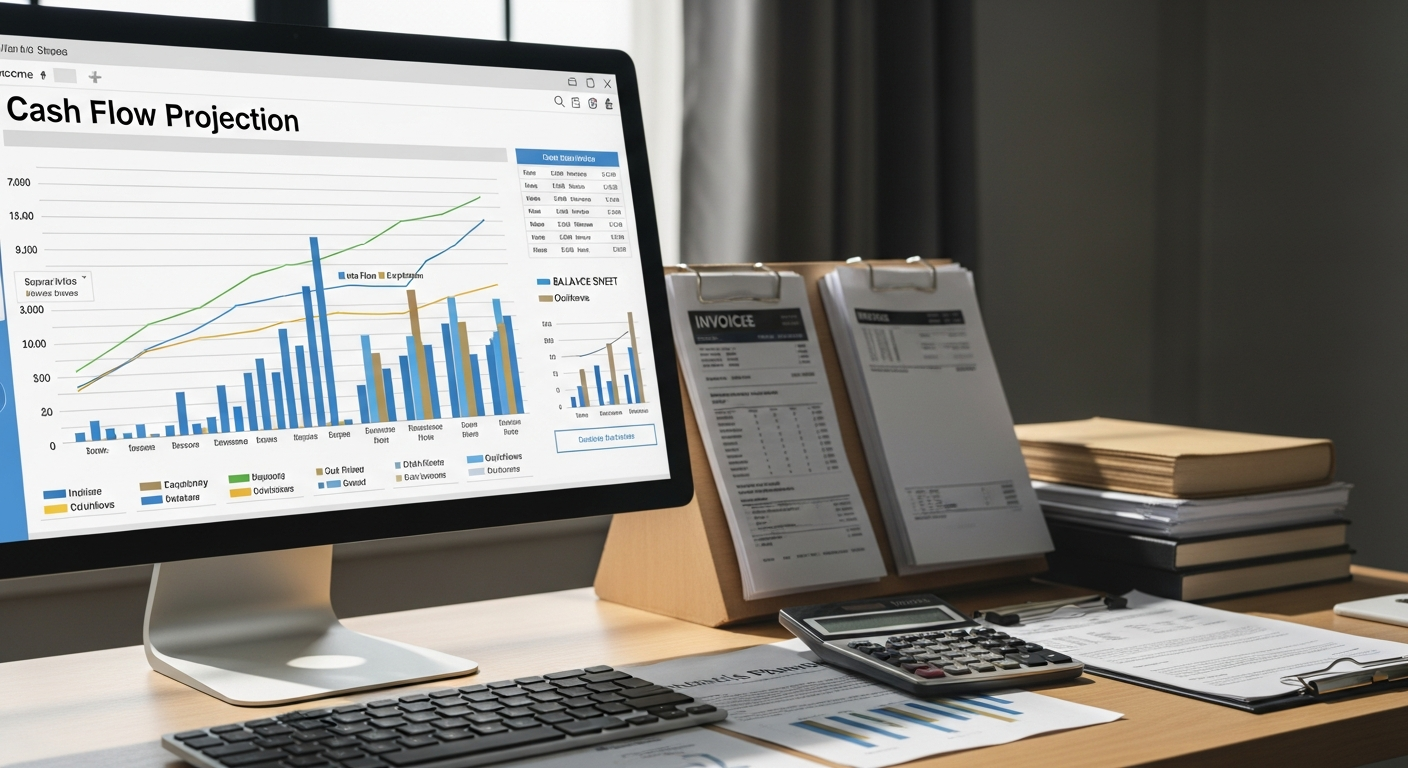
A cash flow forecast projects expected cash inflows and outflows over a future period — typically 12-24 weeks for operational purposes, or 12-24 months for strategic planning.
The 13-Week Rolling Cash Flow:
The most common operational tool is a 13-week rolling cash flow forecast:
- Each week, project expected cash inflows (customer collections based on AR aging) and outflows (payroll, rent, vendor payments, debt service, tax payments)
- The cumulative ending cash balance each week reveals when shortfalls will occur
- Updated weekly with actual results; 13 weeks forward is added as each week passes
This tool allows a business owner to see a cash crunch coming 6-8 weeks in advance — enough time to take action (accelerate collections, draw on a credit line, defer non-essential expenditures).
Annual Cash Flow Planning:
For longer-term planning, a CPA builds an annual cash flow model that:
- Projects monthly revenue collections based on revenue projections and AR timing
- Projects operating expenses with appropriate timing (payroll on specific dates, rent on the 1st, quarterly estimated taxes on quarterly due dates)
- Projects capital expenditures
- Projects debt service (principal + interest by loan)
- Identifies months where the ending cash balance approaches a minimum comfort level
This model helps business owners plan capital needs in advance — knowing in January that August will require a line of credit draw, rather than scrambling when August arrives.
Managing Accounts Receivable
Accounts receivable — money owed to the business by customers — is the primary driver of the gap between profit and cash flow for most service businesses.
Days Sales Outstanding (DSO):
DSO measures how long it takes to collect invoices: DSO = (Accounts Receivable ÷ Annual Revenue) × 365. A business billing $1.2 million annually with $200,000 in AR has a DSO of 61 days — it takes an average of 61 days to collect.
Reducing DSO from 61 to 45 days on $1.2 million in revenue frees up $53,000 in cash — without any change in revenue.
Strategies to Improve Collection:
- Invoice immediately: Don't wait until month-end to invoice. Send the invoice the day the work is complete or the service is delivered.
- Offer early payment discounts: "2/10 net 30" means a 2% discount if paid within 10 days. The effective annual rate this represents is ~37% — often worth it to accelerate collections.
- Require deposits for large projects: A 25-50% deposit upfront reduces the cash flow impact of long projects.
- Accept multiple payment methods: ACH, credit card, digital payments — remove friction from the payment process.
- Follow up systematically: An aging report reviewed weekly, with automatic follow-up at 30, 45, and 60 days past due, prevents receivables from becoming losses.
- Consider invoice factoring: Selling outstanding invoices to a factoring company at a discount (typically 1-5% of invoice value) provides immediate cash.
Managing Accounts Payable
Accounts payable — money owed to suppliers and vendors — is the mirror image of accounts receivable. Managing when you pay affects cash flow as much as managing when you collect.
Strategies:
- Take full advantage of vendor payment terms: If a vendor offers net-30 terms, pay on day 30 — not day 5. Every day of float is a day the cash is in your account.
- Negotiate extended terms with key suppliers: For a major supplier relationship, negotiating net-60 instead of net-30 terms effectively extends a 30-day interest-free loan on all purchases.
- Avoid late fees: Late payment fees and strained vendor relationships are expensive. Staying within terms while maximizing float is the goal.
- Prioritize payments strategically: In a cash crunch, paying payroll taxes before other obligations is critical — the trust fund recovery penalty makes payroll tax delinquency personally costly.
- Use business credit cards strategically: A card with a 25-day float allows purchasing today and paying in 25+ days, effectively extending payment terms.
Tax Payments and Cash Flow Planning
Taxes are one of the most predictable — and most frequently underplanned — cash flow items for small businesses.
Federal and State Income Taxes:
Quarterly estimated tax payments are due in April, June, September, and January. A CPA calculates the specific amounts and builds them into the cash flow forecast so the business isn't surprised.
For S-corp owners, the business itself may have limited tax liability — but the owner's personal return will reflect significant income, requiring personal estimated payments. These must be coordinated with the business's cash flow.
Payroll Taxes:
Payroll tax deposits (for semi-weekly depositors: due within a week of each payroll) are a constant, predictable cash outflow. These are non-negotiable — late deposits trigger automatic penalties.
Sales Tax:
Sales tax collected from customers is not business revenue — it's a liability that must be remitted to the state on the required schedule (monthly, quarterly, or annually). Many businesses treat sales tax collections as operating cash when they're actually being held in trust. A CPA ensures sales tax is properly accounted for and remitted on time.
Financing Options for Cash Flow Gaps
When cash flow analysis reveals upcoming shortfalls, financing options include:
Business Line of Credit:
A revolving line of credit that can be drawn and repaid as needed. The best time to establish a line of credit is when you don't need it — banks lend to healthy businesses, not distressed ones. A $100,000-$500,000 line provides cushion for seasonal cash needs or unexpected gaps.
SBA Loans:
For larger capital needs, SBA 7(a) loans provide competitive rates with longer terms than conventional business loans.
Invoice Financing:
Using outstanding invoices as collateral for a loan, or factoring (selling) invoices for immediate cash.
Equipment Financing:
Rather than paying cash for equipment, financing it preserves working capital. Section 179 and bonus depreciation allow the same tax deduction even on financed equipment.
Frequently Asked Questions
Q: How much cash reserve should a business keep?
The standard recommendation is 3-6 months of operating expenses in accessible cash reserves. For businesses with highly predictable, recurring revenue (subscription businesses, service retainers), 3 months may be adequate. For businesses with seasonal or irregular cash flows, 6+ months provides a more comfortable cushion. The right level depends on your revenue predictability and access to credit lines for unexpected needs.
Q: Why does my business show a profit but I never have cash?
The profit on your income statement and the cash in your bank account differ because of: (1) accrual-basis timing differences (revenue recognized before collection, expenses recognized before payment), (2) debt principal payments (which reduce cash but aren't on the P&L), (3) capital expenditures (which reduce cash but are only gradually expensed through depreciation), and (4) working capital build-up (growing AR, inventory). A cash flow statement shows where the difference went.
Q: What's the difference between cash flow and working capital?
Working capital is a balance sheet measure: current assets minus current liabilities. Cash flow is a measure of movement over time — cash coming in and going out. Working capital shows the buffer of short-term liquidity; cash flow shows whether that buffer is growing or shrinking.
Q: Can a CPA help us get a bank loan?
A CPA helps prepare the financial documentation banks require: GAAP-compliant financial statements, tax returns, cash flow projections, and personal financial statements for owner guarantees. A CPA also helps frame the business's financial story for lenders — normalizing earnings, explaining unusual items, and demonstrating debt service coverage. While the CPA can't guarantee loan approval, good financial preparation significantly improves the odds.
Conclusion
Cash flow management is as important as tax planning — and more immediately consequential. A business that runs out of cash cannot pay employees, cannot purchase inventory, and cannot survive — regardless of how profitable it looks on paper.
A CPA who provides cash flow planning and forecasting gives business owners visibility into their cash position weeks and months in advance — allowing proactive management rather than reactive crisis response. This visibility is particularly valuable during periods of rapid growth, seasonality, or major capital investments.
Our CPA firm provides cash flow forecasting and management as part of our comprehensive business financial services. Contact us to discuss how we can improve your business's financial visibility and management.
Related Articles: